At What Age Do Babies Get Attached to Their Parents
What is a Secure Zipper? And Why Doesn't "Attachment Parenting" Go You There?
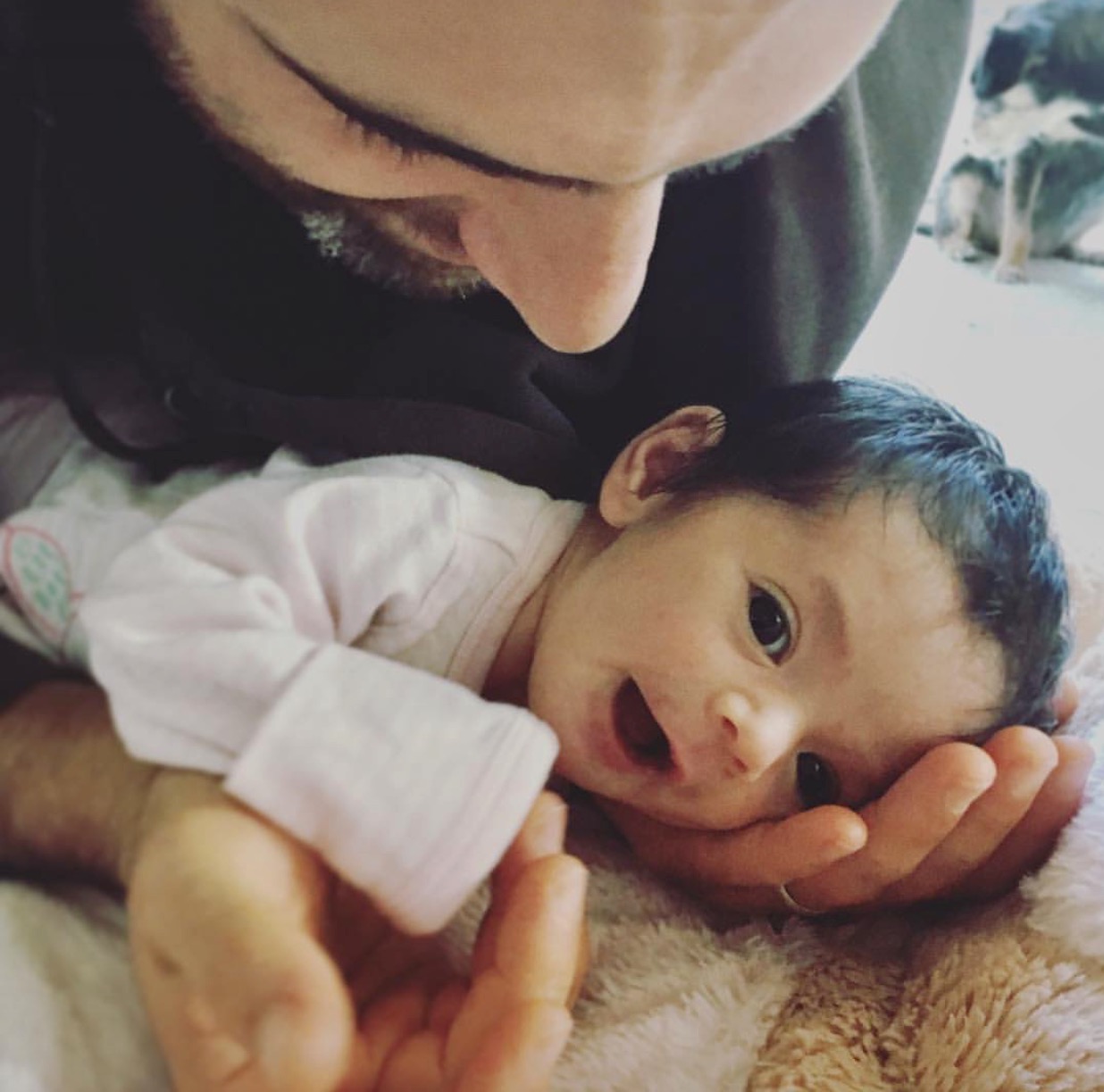
photo credit: Emily Dorrien
A few months agone, a young friend of mine had a infant. She began a home birth with a midwife, merely after several hours of labor, the babe turned to the side and became stuck. The midwife understood that the labor wouldn't proceed, then she hustled the laboring Amelie into the motorcar and collection the half-mile to the emergency room while Amelie's husband followed. The nascency ended safely, and beautiful, tiny Sylvie emerged with a total head of black pilus. The little family of 3 went abode.
When the infant was six weeks quondam, Amelie developed a severe chest infection. She struggled to continue breastfeeding and pumping, simply it was extremely painful, and she was taking antibiotics.[i] Finally she gave in to feeding her baby formula, only she felt distraught and guilty. "Make sure you find some other way to bond with your infant," her pediatrician said, calculation to her distress.
"Piglet sidled upwards to Pooh from backside. "Pooh!" he whispered.
"Yeah, Piglet?"
"Zip," said Piglet, taking Pooh'south manus. "I just wanted to be sure of y'all."
Fortunately, sleep came hands to Sylvie; she slumbered comfortably in a trivial crib next to Amelie'southward side of the bed. Still, at four months, Amelie worried that the bond with her babe wasn't forming properly and she wanted to remedy the trouble by pulling the baby into bed. Baby Sylvie wasn't having it. When she was next to her mother, she fussed; when Amelie placed her dorsum in the crib, she settled. Again, Amelie worried about their relationship.
"Amelie" is an constructing of actual friends and clients I have seen in the concluding month, but all of the experiences are real. And as a developmental psychologist, I experience distressed past this suffering. Because while each of the practices—domicile birth, breastfeeding, and co-sleeping—has its benefits, none of them is related to a baby's secure attachment with her caregiver, nor are they predictive of a baby's mental health and development.
"Attachment is a relationship in the service of a babe'southward emotion regulation and exploration. It is the deep, constant confidence a baby has in the availability and responsiveness of the caregiver."
"Zipper is not a set of tricks," says Alan Sroufe, a developmental psychologist at the Institute for Kid Development at the University of Minnesota. He should know. He and his colleagues take studied the zipper relationship for over xl years.
Why the confusion well-nigh a secure attachment?
Over the last 80 years, developmental scientists have come to sympathise that some micro-dynamics that accept place between a babe and an adult in a caring relationship have a lifelong issue, in very specific means, on the person that infant will get.
"Attachment," Sroufe explains, "is a relationship in the service of a infant'south emotion regulation and exploration. It is the deep, abiding confidence a baby has in the availability and responsiveness of the caregiver."
A secure attachment has at to the lowest degree 3 functions:
-
Provides a sense of rubber and security
-
Regulates emotions, past soothing distress, creating joy, and supporting calm
-
Offers a secure base from which to explore
In spite of the long scientific history of attachment, psychologists have done a rather poor job of communicating what a secure attachment is and how to create one. In the meantime, the word "attachment" has been co-opted by a well-meaning pediatrician and his wife, William and Martha Sears, along with some of their children and an entire parenting motion. The "zipper parenting" philosophy promotes a lifestyle and a specific set of practices that are not proven to be related to a secure zipper. As a result, the motility has sown confusion (and guilt and stress) around the meaning of the word "attachment."
The attachment parenting philosophy inspired by the Searses and promoted by an organization called Attachment Parenting International is centered on viii principle concepts, particularly breastfeeding, co-sleeping, constant contact like babe-wearing, and emotional responsiveness. The approach is a well-intentioned reaction to earlier, harsher parenting advice, and the tone of the guidance tends to exist baby-centered, supportive, and loving. Some of the practices are benign for reasons other than attachment. Merely the advice is oft taken literally and to the extreme, as in the case of my "Amelie," whose labor required hospital intervention and who suffered unduly in the belief that breastfeeding and co-sleeping are necessary for a secure attachment.
Attachment parenting has likewise been roundly critiqued for promoting a bourgeois Christian, patriarchal family structure that keeps women at dwelling and tied tightly to their baby's desires. Additionally, the philosophy seems to accept morphed in the public consciousness into a lifestyle that as well includes organic food, fabric diapers, rejection of vaccinations, and homeschooling. The Searses have sold millions of books, and they profit from endorsements of products that serve their advice.
"These [zipper parenting principles] are all fine things," observes Sroufe "but they're not the essential things. There is no evidence that they are predictive of a secure attachment."
Sroufe unpacks feeding as an example: A female parent could breastfeed, but practise it in a mechanical and insensitive fashion, potentially contributing to an insecure zipper. On the other paw, she could canteen-feed in a sensitive manner, taking cues from the baby and using the interaction as an opportunity to look, talk, and play gently, according to the infant'southward communication—all behaviors that are probable to create secure attachment. In other words, information technology is the quality of the interaction that matters. Now, 1 might choose breastfeeding for its digestibility or diet (though the long-term benefits are still debated), but to imply, as Amelie'due south pediatrician did, that bottle-feeding could harm her bail with her baby is simply uninformed.
There is also confusion about what "abiding contact" means. Early on, the Searses were influenced by the continuum concept, a "natural" approach to parenting inspired by indigenous practices of wearing or carrying babies much of the time. This, too, might have been taken up in reaction to the advice of the day, which was to treat children in a more than businesslike fashion. There is no arguing that skin-to-skin contact, shut physical contact, holding, and conveying are all good for babies in the first few months of life, as their physiological systems settle and organize. Research also shows that the practice can reduce crying in the first few months. Only again, what matters for zipper is the caregiver'due south orientation and attunement: Is the caregiver stressed or calm, checked out or engaged, and are they reading a baby's signals? Some parents misinterpret the prescription for closeness as a need for abiding physical closeness (which in the extreme tin can stress any parent), even though the Searses do advise parents to strive for a balanced life.
"There's a difference between a 'tight' connexion and a secure attachment," Sroufe explains. "A tight attachment—together all the time—might actually be an anxious attachment."
And what of emotional responsivity? This, besides, has a kernel of truth, still can be taken too far. It is safety to say that all developmental scientists encourage emotional responsiveness on the part of caregivers: The back-and-along, or serve-and-render, is crucial to brain development, cognitive and emotional evolution, the stress regulation system, and just accurate human connection. But in my observation, well-pregnant parents can get overly-responsive—or permissive—in the conventionalities that they need to see every request of the child. While that is appropriate for babies in the first half to one-yr yr of life (yous can't spoil a baby), toddlers and older children benefit from historic period-appropriate limits in combination with warmth and dearest. On the other paw, some parents feel stressed that they cannot give their child plenty in the midst of their other responsibilities. Those parents tin accept some comfort in the finding that even inside a secure attachment, parents are only attuned to the baby about 30% of the time. What is important, researchers say, is that the infant develops a generalized trust that their caregiver will reply and meet their needs, or that when mismatches occur, the caregiver will repair them (and babies, themselves, will go a long manner toward soliciting that repair). Equally long as the caregiver returns to the interaction much of the time and rights the baby's boat, this flow of attunements, mismatches, and repairs offers the optimal corporeality of connection and stress for a babe to develop both conviction and coping, in balance.
What is the scientific view of attachment?
The scientific notion of zipper has its roots in the piece of work of an English psychiatrist named John Bowlby who, in the 1930s, began working with children with emotional problems. Virtually professionals of the twenty-four hours held the Freudian belief that children were mainly motivated past internal drives like hunger, aggression, and sexuality, and non by their environment. However, Bowlby noticed that nearly of the troubled children in his care were "affectionless" and had experienced disrupted or fifty-fifty absent caregiving. Though his supervisor forbade him from fifty-fifty talking to a mother of a child (!), he insisted that family unit experiences were important, and in 1944 he wrote his get-go business relationship of his observations based on 44 boys in his care. (Around the aforementioned fourth dimension in America, psychologist Harry Harlow was coming to the same decision in his fascinating and middle-rending studies of baby monkeys, where he observed that babies sought comfort, and not just food, from their mothers.)
Bowlby went on to report and treat other children who were separated from their parents: those who were hospitalized or homeless. He came to believe that the primary caregiver (he focused mainly on mothers) served as a kind of "psychic organizer" to the child, and that a kid needs this influence, especially at certain times, in order to develop successfully. To grow upwards mentally good for you, then, "the baby and immature child should experience a warm, intimate, and continuous human relationship with this mother (or permanent mother substitute) in which both observe satisfaction and enjoyment."
Merely the zipper figure doesn't accept to be the mother or even a parent. Co-ordinate to Bowlby, babies class a "small bureaucracy of attachments." This makes sense from an evolutionary view: The number has to be small since attachment organizes emotions and beliefs in the infant, and to take too many attachments would be confusing; all the same having multiples provides the safe of backups. And it'south a hierarchy because when the infant is in need of prophylactic, he or she doesn't have time to analyze the pros or cons of a particular person and must automatically turn to the person already determined to exist a reliable comfort. Inquiry shows that children who have a secure zipper with at least i developed experience benefits. Babies can form attachments with older siblings, fathers, grandparents, other relatives, a special developed outside the family unit, and fifty-fifty babysitters and daycare providers. However, at that place will notwithstanding be a hierarchy, and under normal circumstances, a parent is ordinarily at the top.
In the 1950s, Mary Ainsworth joined Bowlby in England, and a decade later back in the U.S. began to diagnose different kinds of relationship patterns between children and their mothers in the second year of life.[2] She did this by watching how babies reacted in a sequence of situations: when the babe and female parent were together, when they were separated, when the baby was with a stranger, and when infant was reunited with the caregiver afterward the separation. Ainsworth and colleagues identified the first three of the following patterns, and Mary Principal and colleagues identified the fourth:
-
When babies take a secure attachment, they play and explore freely from the "secure base" of their mother's presence. When the mother leaves, the baby can go distressed, specially when a stranger is around. When the female parent returns, the baby expresses her joy, sometimes from a distance and sometimes reaching to be picked up and held (babies vary, depending on their personality and temperament, even within a secure attachment). Then the baby settles chop-chop and returns to playing.
The mothers who fall into this pattern are responsive, warm, loving, and emotionally available, and as a consequence their babies grow to exist confident in their mothers' power to handle feelings. The babies experience complimentary to express their positive and negative feelings openly and don't develop defenses confronting the unpleasant ones.
-
Babies in insecure-avoidant attachments seem indifferent to the female parent, human activity unstressed when she leaves, and exhibit the same behaviors with a stranger. When the mother returns after a separation, the infant might avert her, or might "fail to cling" when picked up.
The mothers in insecure-avoidant attachments often seem angry in general and aroused, specifically, at their babies. They can be intolerant, sometimes punishing, of distress, and oftentimes attribute wrong motivations to the baby, e.yard., "He's but crying to spite me." I written report showed that the insecurely-fastened babies are just as physiologically upset (increased eye rates, etc.) as securely attached babies when parents leave but have learned to suppress their emotions in order to stay close to the parent without risking rejection. In other words, the babies "deactivate" their normal attachment organization and stop looking to their mothers for help.
As toddlers, insecure-avoidant children don't pay much attention to their mothers or their ain feelings, and their explorations of the physical world are rigid and cocky-reliant. By preschool, these children tend to be more hostile, aggressive, and accept more negative interactions overall. Avoidance and emotional altitude become a way of dealing with the globe, and instead of trouble-solving, they are more likely to sulk or withdraw.
-
Babies with an insecure-clashing/resistant attachment are clingy with their female parent and don't explore or play in her presence. They are distressed when the female parent leaves, and when she returns, they vacillate between clinging and aroused resistance. For example, they may struggle, hit, or push back when the mother picks them upwardly.
These babies are non hands comforted. They seem to want the close relationship, simply the mother'southward inconsistency and insensitivity undermine the baby'south confidence in her responses. This pattern also undermines the child'due south autonomy, because the baby stays focused on the female parent'south behavior and changing moods to the exclusion of most everything else. In insecure-ambivalent babies, separation anxiety tends to final long afterward secure babies have mastered information technology. Longitudinal studies show that these children ofttimes get inhibited, withdrawn, and unassertive, and they have poor interpersonal skills.
-
The terminal pattern of insecure attachment—which is the most agonizing and destructive—is disorganized attachment, and it was described by Ainsworth's doctoral student, Mary Main. This pattern can occur in families where there is abuse or maltreatment; the female parent, who is supposed to be a source of back up, is also the person who frightens the kid. Such mothers may be directly maltreating the child, or they might have their own histories of unresolved trauma. Main and her colleague write, "[T]he infant is presented with an irresolvable paradox wherein the oasis of rubber is at once the source of alarm."
This blueprint tin can also result when the mother has a mental disease, substance habit, or multiple gamble factors like poverty, substance abuse and a history of being mistreated. Babies of mothers like this can be flooded with anxiety; alternatively, they can be "checked out" or dissociated, showing a flat, dead bear on or odd, frozen postures, even when held by the mother. Later on these children tend to become controlling and aggressive, and dissociation remains a preferred defense mechanism.[iii]
"The emotional quality of our earliest attachment experience is perhaps the single most important influence on man evolution."
How important is attachment?
"Goose egg is more important than the zipper relationship," says Alan Sroufe, who, together with colleagues, performed a serial of landmark studies to discover the long-term touch of a secure attachment. Over a 35-year period, the Minnesota Longitudinal Study of Risk and Adaption (MLSRA) revealed that the quality of the early on attachment reverberated well into subsequently babyhood, adolescence, and machismo, even when temperament and social grade were deemed for.
I of the most of import—and, to some ways of thinking, paradoxical—findings was that a secure attachment early in life led to greater independence after, whereas an insecure attachment led to a kid being more dependent afterward in life. This conclusion runs counter to the conventional wisdom held by some people I've observed who are specially eager to make the babe as independent and self-sufficient equally possible right from the first. Merely there is no pushing independence, Sroufe found. It blooms naturally out of a secure attachment.
In school, securely attached children were more well-liked and treated better, by both their peers and their teachers. In ane written report, teachers who had no knowledge of a child's attachment history were shown to treat securely fastened children with more warmth and respect, set more historic period-advisable standards, and have higher expectations. In contrast, teachers were more than decision-making, had lower expectations, got angry more ofttimes, and showed less nurturing toward the children with difficult attachments—and who, sadly, had a greater need than the securely attached kids for kindness from adults.
The MSLRA studies showed that children with a secure attachment history were more likely to develop:[iv]
-
A greater sense of self-bureau
-
Meliorate emotional regulation
-
College self-esteem
-
Better coping under stress
-
More than positive engagement in the preschool peer grouping
-
Closer friendships in middle childhood
-
Better coordination of friendships and social groups in adolescence
-
More trusting, non-hostile romantic relationships in adulthood
-
Greater social competence
-
More leadership qualities
-
Happier and better relationships with parents and siblings
-
Greater trust in life
A large trunk of additional research suggests that a kid's early attachment affects the quality of their adult relationships, and a recent longitudinal report of 81 men showed that those who grew upwardly in warm, secure families were more likely to have secure attachments with romantic partners well into their 70s and 80s. A parent's history of babyhood zipper tin can also affect their ability to parent their own child, creating a cross-generational manual of attachment styles.
But early childhood attachment with a parent is not destiny: It depends on what else comes forth. For instance, a secure preschool kid can shift to having an insecure attachment later if there is a astringent disruption in the caregiving system—a divorce or death of a parent, for example. But the upshot is mediated past how stressed and available the principal attachment figure is. In other words, it's not what happens, simply how information technology happens that matters. Children who were previously secure, though, take a tendency to rebound more than easily.
Sroufe writes in several articles that an insecure zipper is non fate, either; it can be repaired in a subsequent relationship. For example, good-quality childcare that offers emotional support and stress reduction can mitigate a rocky start at home. A after healthy romantic relationship can start the effects of a hard babyhood. And good therapy can help, besides, since some of the therapeutic process mimics the attachment process. Bowlby viewed development as a series of pathways, constrained by paths previously taken but where alter is e'er possible.
Without conscious intervention, though, attachment styles practise tend to go passed through the generations, and Bowlby observed that becoming a parent peculiarly activates a parent's babyhood attachment style. Ane study looked at zipper styles over three generations and constitute that the female parent's attachment style when she was pregnant predicted her infant's attachment style at i twelvemonth of historic period for well-nigh 70% of cases.
What most parents who might not have gotten a good start in life and want to change their attachment style? There'south skillful news. Enquiry on developed attachment shows that it is non the bodily babyhood experiences with zipper that affair just rather how well the adult understands what happened to them, whether they've learned some new ways of relating, and how well they've integrated their experience into the present. In other words, do they have a coherent and realistic story (including both skillful and bad) of where they've been and where they are now?
Back up matters, as well. In one of Sroufe'due south studies, one-half the mothers were teenagers, which is usually a stressful situation. Sroufe plant that the teenagers with good social support were able to class secure attachments with their babies, but if they didn't have support, they were unlikely to course a secure attachment.
How to parent for a secure attachment and how to know if information technology's working.
"The baby needs to know that they're massively important," says Sroufe. "A caregiver should be involved, circumspect, sensitive, and responsive."
"The infant volition tell you what to do," Sroufe explains. "They have a limited mode of expressing their needs, so they're not that difficult to read: If they're fussing, they demand something. If their artillery are out, they want to be picked upward. And if yous misread them, they volition go along on signaling until you get it right." He gives the example of bottle-feeding a babe: "The infant might want a break, and she looks effectually. What does the baby want? To look around! If the parent misreads and forces the canteen back, the baby will insist, mayhap snap her caput away, or pull abroad harder."
"How can I know if my baby is securely attached?" a customer asked me about her six-month old. Clearly observable zipper doesn't sally until effectually 9 months, just here are some clues that a secure zipper is underway:
0-three months:
-
The baby's physiology is just settling as the baby cycles quickly among feeding, sleeping, and warning wakefulness. Meeting the baby's needs at different points in the cycle helps found stability.
-
At this point, the baby has no clear preference for 1 person over some other.
-
In her placidity, alarm state, the baby is interested in the faces and voices around her.
4-8 months:
-
Attempts to soothe the baby are usually effective at calming her down. (Caveat: An inability to soothe might non exist predictive of insecurity but rather point to i of a host of other possible problems.)
-
The main caregiver has positive interactions with the baby where the back-and-forth is pleasant.
-
The baby has calm periods where she is interested in the world effectually her, and she explores and experiments to the extent she is physically able to—looking, grasping, reaching, babbling, beginning crawling, exploring objects with her mouth, easily, etc.
-
Infants brainstorm to discriminate betwixt people and start to show preferences. They straight near of their emotions (smiles, cries) toward the caregiver but are still interested in strangers.
-
They are very interested in the people they see oft, specially siblings.
9 months:
-
The baby shows a clear preference for a primary caregiver.
-
The baby shows wariness toward strangers, though the degree varies with temperament.
-
The baby is hands upset when separated from her primary caregiver, though that, too, varies with temperament.
-
The baby is hands soothed after a separation and can resume her exploration or play.
9 months – 3 years:
-
The child shows a clear emotional bond with a primary person.
-
The child stays in close proximity to that person but forms close relationships with other people who are around a lot, as well, e.k., babysitter, siblings.
Beyond this age, the attachment relationship becomes more elaborated. With language and memory, the rhythms of attachment and separation become more negotiated, talked about, and planned, and at that place is more of a back-and-along between parent and child. By toddlerhood and beyond, an authoritative parenting style deftly blends secure attachment with age-appropriate limits and supports. A sensitive parent allows the changing zipper to grow and stretch with a child'south growing skills, yet continues to be emotionally attuned to the kid and to protect their safety.
One of the best resources for how to parent for a secure zipper in the showtime few years of life is the new book Raising A Secure Child by Kent Hoffman, Glen Cooper, and Bert Powell, all therapists who accept worked with many different kinds of families for decades. Their piece of work is based squarely on the scientific discipline of attachment, and they phone call their approach the Circle of Security. The circle represents the seamless ebb and flow of how babies and young children need their caregivers, at times coming close for care and comfort, and at other times following their inspiration to explore the globe around them. The caregivers' role is to tune into where on the circle their child is at the moment and deed accordingly. Parenting for a secure attachment, the authors say, is not a prescriptive set of behaviors simply more a state of heed, a way of "being with" the baby, a sensitivity to what they are feeling. The authors also help parents see the means that their own attachment history shows up in their parenting and help them to make the necessary adjustments.
The neurobiology of attachment
"Attachment theory is essentially a theory of regulation," explains Allan Schore, a developmental neuroscientist in the Section of Psychiatry at the UCLA David Geffen School of Medicine. A clinician-scientist, he has elaborated modern attachment theory over the last three decades by explaining how the attachment relationship is important to the child'south developing encephalon and body.
Early brain evolution, Schore explains, is not driven merely by genetics. The brain needs social experiences to take shape. "Mother Nature and Mother Nurture combine to shape Human Nature," he writes.
Infants grow new synapses, or neural connections, at a rate of twoscore,000 new synapses a second, and the brain more than doubles in volume across the showtime year. Genetic factors drive this early on overproduction of neurons, Schore explains, but the brain awaits direction from the social environment, or epigenetic processes, to determine which synapses or connections are to exist pruned, which should be maintained, and which genes are turned on or off.
Ane of the first areas of the brain that begins to grow and differentiate is the right brain, the hemisphere that processes emotional and social data. The right brain begins to differentiate in the terminal trimester in utero, whereas the left-brain evolution picks up in the second twelvemonth of life. Some of the regions that process emotion are already nowadays in infants' brains at birth—the amygdala, hypothalamus, insula, cingulate cortex, and orbitofrontal cortex. Simply the connections amongst these areas develop in specific patterns over the first years of life. That'south where input from the master relationship becomes crucial—organizing the hierarchical circuitry that volition eventually procedure, communicate, and regulate social and emotional information.[v]
"What the primary caregiver is doing, in being with the babe," explains Schore, "is allowing the child to experience and to identify in his own body these different emotional states. Past having a caregiver only 'be with' him while he feels emotions and has experiences, the babe learns how to be," Schore says.
The part of the brain that the primary caregiver uses for intuition, feeling, and empathy to attune to the baby is also the caregiver's right brain. So it is through "right-brain-to-right brain" reading of each other, that the parent and child synchronize their energy, emotions, and advice. And the behaviors that parents are inclined to do naturally—like center contact and face up-to-confront interaction, speaking in "motherese" (higher-pitched and slower than normal oral communication), and holding—are just the ones shown to grow the correct-brain regions in the babe that influence emotional life and especially emotion regulation.
The testify for epigenetic effects on emotion regulation is quite solid: Early caregiving experiences can impact the expression of the genes that regulate a infant's stress and they tin can shape how the endocrine organisation will mobilize to stress. Caregiving behaviors like responsiveness affect the development of the babe's vagal tone (the calming organization) and the hypothalamic-pituitary axis (the system that activates the torso to respond to perceived danger). High quality caregiving, then, modulates how the encephalon and body answer to and manage stress.
Schore points out that the ventromedial prefrontal cortex, a brain region in the right hemisphere, both has the almost complex emotion and stress-regulating systems of whatsoever function in the brain and is likewise the center of Bowlby'south attachment control system. Neurobiological inquiry confirms that this region is "specifically influenced by the social environment." [6]
Stress management is not the simply important part of emotion regulation. In the past, Schore explains, in that location was an overemphasis in the field of emotion regulation on singularly lowering the baby's distress. But at present, he says, we understand that supporting positive emotional states is equally important to creating [what he quotes a colleague every bit calling] a "background state of well-being." In other words, savor your babe. It's protective.
A infant's emotion regulation begins with the caregiver, and the Goldilocks principle applies: If the caregiver'south emotions are also loftier, the stimulation could be intrusive to the baby, Schore explains. As well low, and the baby'southward "groundwork state" settles at a depression or mayhap depressive emotional baseline. Just right, from the baby's signal of view is best.
And babies are surprisingly perceptive at registering their feeling environment. Hoffman, Cooper and Powell write:
The youngest babies tin can sense ease versus impatience, delight versus resentment or irritation, comfort versus restlessness, genuine versus pretending, or other positive versus negative responses in a parent when these reactions aren't evident to a casual observer. Niggling babies may pick up on the smallest sigh, the subtlest shift in tone of voice, a certain glance, or some type of body language and know the parent is genuinely comfortable or definitely not pleased.
Schore explains that in a secure attachment, the babe learns to self-regulate in two ways: Ane he calls "autoregulation" which is self-soothing, or using his own mind and body to manage feelings. The second is "interactive regulation" which is going to other people to aid upwardly- or downward-regulate feelings. This twin thread of self-reliance and reliance on others, then, begins in the earliest months, becomes very important in the first ii years of life, and continues in more subtle means throughout the life span.
This all might sound daunting for a new parent, who could still be tempted to overdo the focus on the infant and how the connectedness is going—potentially leading to the same kinds of stress and guilt that the zipper parenting movement creates.
But fortunately, the caregiver doesn't have to be 100% attuned to the babe and ongoing repairs are an of import office of the process:
"The idea that a mother should never stress a baby is problematic," Schore says. "Insecure attachments aren't created just by a caregiver's inattention or missteps. It also comes from a failure to repair ruptures. What is essential is the repair. Possibly the caregiver is coming in too fast and needs to back off, or maybe the caregiver has not responded, and needs to show the infant that she'south there. Either style, repair is possible, and information technology works. Stress is a role of life, and what nosotros're trying to do hither is to ready a organization past which the baby tin learn how to cope with stress." Optimal stress, he explains, is important for stimulating the stress-regulating organisation.
Even so, both Sroufe and Schore admit the emotional labor of parenting. And they are tearing that parents need to exist supported in order to have the infinite and freedom to care for babies.
"It takes time for parents to learn to read their baby's signals," Sroufe said.
Schore calls America'due south failure to provide paid family get out—and we're the but country in the world that doesn't—the "shame of America."
"Nosotros are putting the next generation at risk," he explains, pointing to rising rates of insecure attachments and plummeting mental health among American youth. Parents should have at to the lowest degree six months of paid leave and job protection for the principal caregiver, and at least ii months of the same for the secondary one, according to Schore, and Sroufe goes farther, advocating for one total yr of paid leave and task protection. And a recent study showed that it takes mothers a year to recover from pregnancy and delivery.
Intellectual and cognitive development take been privileged in our guild, merely it is our emotion regulation that organizes us, our existence, and how we feel life, Schore says. A written report from the London Schoolhouse of Economics draws the determination that "The virtually important childhood predictor of developed life-satisfaction is the child's emotional health…. The to the lowest degree powerful predictor is the kid'southward intellectual development."[7]
Then where does this leave my friend Amelie? The hard role will exist navigating the distracting advice and creating the workarounds she needs for the lack of cultural back up. But she enjoys her baby immensely, and I'k confident that she'll form a secure attachment with Sylvie, equally she trusts her ain "right-encephalon" flow of empathy, feeling, and beingness, and tunes in to Sylvie's own unique means of communicating.
And Sylvie volition practice her function to depict her parents close. Because regardless of babies' individual personalities—and whether they cry a lot or sleep very little, whether they're breastfed or bottle-fed—they draw you in with their wide-open gaze, their milky aroma, and their tiny fingers that roll effectually your big ones. Before you know it, they calorie-free you up with their full-trunk smiling that's specially for y'all, and they draw you near with their plump piffling arms clasped effectually your neck.
And the sweet elixir of the attachment relationship is underway.
References:
[one] While many medications are considered rubber to take while breastfeeding, consummate side furnishings may non be fully understood. For example, contempo enquiry suggests antibiotics may change the test baby's microbiome (the implications of which are unclear), and some antibiotics are thought to discolor developing teeth.
[2] This department refers to primary caregivers equally mothers since this research focused but on mothers.
[3] This section was adjusted from the chapter on Attachment, in D. Davies' Child Development: A Practitioner's Guide, Guilford, 2011.
[4] Sroufe, A. & Siegel, D. "The verdict is in: The case for attachment theory."
[v] From Schore, A. (2017). Mod zipper theory, in APA's Handbook of Trauma Psychology, p. half dozen.
[6] Schore, A. (2017). "Modernistic zipper theory." In APA Handbook of Trauma Psychology: Vol 1 (publication pending).
[7] http://onlinelibrary.wiley.com/doi/10.1111/ecoj.12170/full p. F720, in Layard,R., Clark, A.E., Cornaglia, F., Powdthavee, N. & Vernoit, J. (2014) What predicts a successful life? A life-grade model of well-existence. The Economic Periodical, 124, p. F720-F738.
Source: https://www.developmentalscience.com/blog/2017/3/31/what-is-a-secure-attachmentand-why-doesnt-attachment-parenting-get-you-there
0 Response to "At What Age Do Babies Get Attached to Their Parents"
Postar um comentário